Petals and Pixels: How Japanese Garden Philosophy Secretly Drives Anime's Most Emotional Scenes
That Feeling You Can't Quite Name
You're watching an anime. Maybe it's a quiet scene — no dramatic music, no big plot twist. Just a character standing in a garden, watching petals drift off a branch. And somehow, your chest tightens. You feel something heavy and beautiful at the same time, and you're not totally sure why.
Welcome to the experience that millions of Western anime fans have had without realizing there's a 1,000-year-old cultural framework behind it. Japanese animators don't just use nature as pretty background filler. They're pulling from a deep well of botanical and garden philosophy that's baked into Japanese aesthetics at a foundational level. Understanding that framework doesn't just make you a smarter viewer — it completely changes how you experience shows like Fruits Basket, A Silent Voice, and Your Lie in April.
Wabi-Sabi: Finding Beauty in the Broken
Let's start with wabi-sabi, probably the most misunderstood Japanese concept that gets tossed around in Western design circles. In its truest sense, wabi-sabi is the philosophy of finding profound beauty in impermanence and imperfection. A cracked tea bowl. A moss-covered stone. A flower that's already starting to wilt.
In anime, this shows up constantly — and Fruits Basket is one of the best examples. The series is absolutely loaded with garden imagery, particularly in scenes involving Tohru Honda's emotional arc. The show's animators frequently frame her in overgrown or slightly unkempt natural settings rather than manicured, picture-perfect landscapes. That's intentional. Tohru herself is a character defined by loss, resilience, and quiet imperfection, and the visual environment around her reflects that same wabi-sabi quality. The beauty isn't in the pristine — it's in the weathered.
For American viewers who grew up with the idea that nature in media should look like a national park calendar photo, this can feel subtly off at first. But that slight discomfort? That's the aesthetic doing its job. You're meant to sit with the imperfection rather than look past it.
Ma: The Power of Negative Space
If wabi-sabi is about texture and imperfection, ma is about emptiness and pause. Translated loosely as "negative space" or "interval," ma is the Japanese concept that the space between things carries just as much meaning as the things themselves.
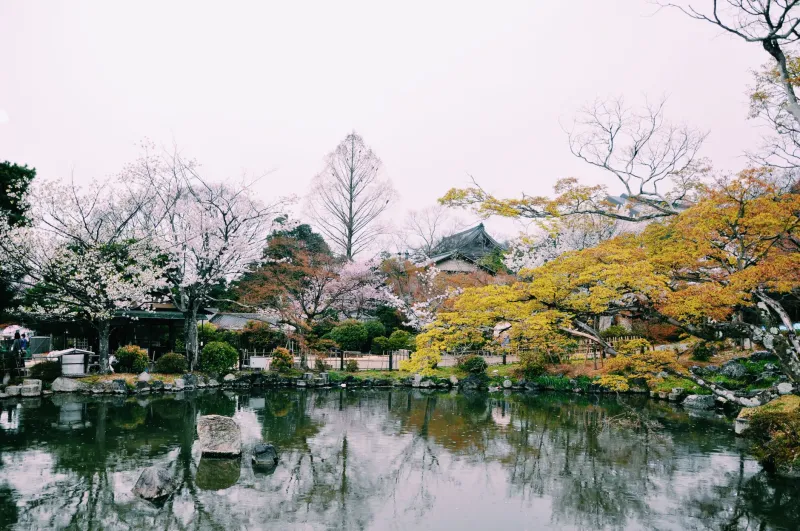
In traditional Japanese garden design, ma is why a garden doesn't try to fill every square inch with plants. The raked gravel around a stone grouping in a Zen garden isn't empty — it's actively communicating stillness, distance, and contemplation.
Anime directors apply this principle directly to cinematography. Think about the scene in A Silent Voice where Shoya and Shoko stand on the bridge during the summer festival. Director Yoshiyuki Yamada and the team at Kyoto Animation frame wide shots with enormous amounts of open sky and water. The characters look small. The silence stretches. Western filmmaking convention might fill that space with a swell of music or a cut to a reaction shot, but the film lets the ma breathe. That openness communicates emotional distance between the characters more powerfully than any line of dialogue could.
Once you start noticing ma in anime, you'll realize it's everywhere — and you'll start appreciating the quiet scenes as much as the action ones.
Seasonal Symbolism: Nature as Emotional Calendar
Japanese culture has an incredibly sophisticated relationship with the seasons, rooted partly in classical literature and poetry (think mono no aware — the bittersweet awareness of things passing) and partly in the agricultural and ceremonial traditions that shaped Japanese garden design for centuries.
In anime, the season a scene takes place in is almost never arbitrary. Spring — especially cherry blossom season, or sakura — represents new beginnings, hope, and the ache of things that don't last. Summer is intensity, youth, and a kind of reckless aliveness. Autumn carries grief, transition, and nostalgia. Winter is isolation, death, and the quiet before renewal.
Fruits Basket uses this seasonal framework so deliberately that the show's entire emotional structure maps onto the Japanese agricultural calendar. The Sohma family curse, the relationships between characters, the moments of breakthrough — they're all choreographed against seasonal backdrops that an audience familiar with Japanese cultural shorthand will read instantly. For Western viewers, the effect still lands emotionally, even without the cultural context, because the visual language is so well-crafted.
But knowing the system makes it richer. When you see Kyo standing in a garden full of late-autumn leaves, you're not just watching a moody visual. You're watching the show tell you something specific about where his story is headed.
The Garden as Character
One of the most interesting things that happens when animators lean into botanical aesthetics is that the natural environment stops being a backdrop and starts functioning almost like a character in its own right.
In The Garden of Words (Makoto Shinkai, 2013), the garden in Shinjuku Gyoen National Garden is the entire emotional container of the film. The rain, the moss, the sheltered walkway — they create a world that exists slightly outside of regular life, a liminal space where the two leads can exist in their unusual relationship. When the season shifts and the garden changes, the relationship has to change too. The garden doesn't just reflect the story. It drives it.
Shinkai in particular has become the most internationally recognized animator when it comes to using natural imagery with this kind of intentionality. His backgrounds are famously photorealistic, but they're not documentary — every cloud formation, every beam of light through leaves, every rain-soaked street is composed to carry emotional weight. He's essentially doing what Japanese garden designers have done for centuries: shaping a natural environment to produce a specific inner experience in the viewer.
What This Means for You as a Western Fan
Here's the thing — you don't need a degree in Japanese aesthetics to appreciate any of this. The animators who use these techniques are crafting visuals that work across cultural lines. That's why anime has exploded in popularity in the US over the past decade. The emotional language of the imagery is genuinely universal.
But if you want to go deeper, even a surface-level familiarity with wabi-sabi, ma, and seasonal symbolism will completely transform your viewing experience. Suddenly the slow scenes have purpose. The sparse backgrounds communicate. The wilting flower isn't just pretty — it's a whole paragraph of storytelling compressed into a single frame.
Next time you're watching and a garden scene hits different, pause for a second. Ask yourself what the plants look like — perfect or imperfect? What's in the empty space around the characters? What season is it, and what does that season mean? You might be surprised how much the anime is already telling you, in a language you're just starting to learn.