Waiting Is the Point: What Anime's Seasonal Gaps Actually Do to Your Brain
Somewhere between the end of a cour and the announcement of a second season, something strange happens. You finish the last episode, you sit with the credits rolling, and then — nothing. No autoplay. No next episode. Just you, a lingering plot thread, and the knowledge that answers might be six months away, or a year, or maybe never.
For a lot of American fans who grew up on Netflix drops and same-day streaming queues, that silence can feel like a glitch. Like something broke. But here's the thing: it didn't break. That pause is working exactly as intended.
The Machine That Never Turns Off
Let's be honest about what Western streaming culture has done to us. The binge model — pioneered by Netflix and now copied by basically everyone — is built on a single premise: keep you watching. Autoplay removes the decision point. Full-season drops eliminate the week-long gap. Even the interface is engineered to make stopping feel like the weird choice.
The psychological effect of that design isn't neutral. Researchers who study media consumption have noted that the binge model compresses what used to be a drawn-out emotional experience into something closer to a sugar rush. You feel a lot, quickly, and then it's over. The show ends, the feeling fades, and you're already looking for the next thing before you've processed what you just watched.
Anime doesn't work that way. At least, not structurally.
The seasonal cour system — roughly 12 to 13 episodes aired weekly over a three-month window — means that even when you're watching simulcasts legally through Crunchyroll or Funimation, you're still waiting. One episode a week. Then a gap. Then maybe another cour. Then possibly a long hiatus while the studio catches up with the manga, or while a sequel gets greenlit, or while the production schedule sorts itself out.
That rhythm isn't accidental, and it isn't just a production constraint. It mirrors something much older.
Ma: The Space That Isn't Empty
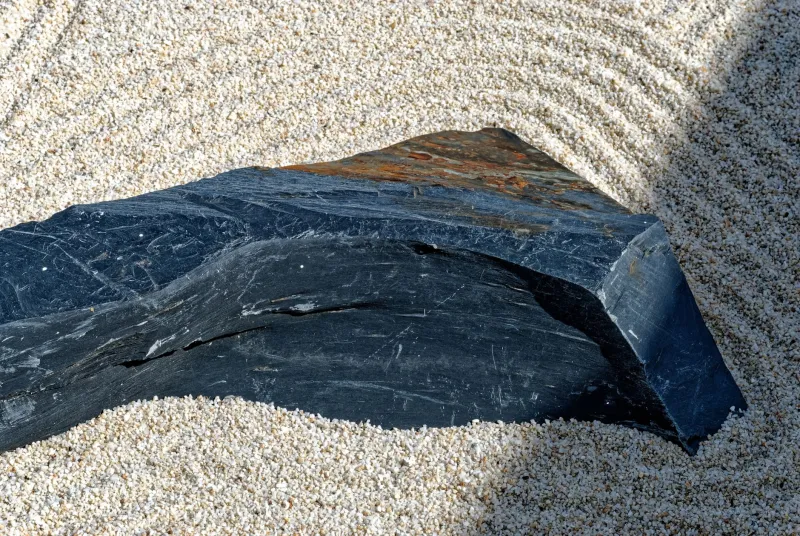
In Japanese aesthetics, there's a concept called ma (間) — often translated as "negative space" or "pause," but that translation undersells it. Ma isn't the absence of something. It's the presence of a gap that carries meaning. You find it in traditional music, where the silence between notes is as intentional as the notes themselves. You find it in garden design, where empty gravel or open space is doing active compositional work. You find it in architecture, in conversation, in the structure of a haiku.
The idea is that space creates meaning. That the pause is where your mind fills in, interprets, and emotionally processes what came before.
Anime's seasonal structure, whether by design or by happy accident, functions a lot like ma. The gap between episodes — and especially the gap between seasons — isn't dead air. It's an invitation for your brain to do something it rarely gets to do in the binge era: sit with unresolved feelings.
Think about the last time a show's mid-season cliffhanger lived in your head for a week. You probably turned it over while you were commuting, or in the shower, or half-asleep. You built theories. You rewatched scenes. You went online and read other fans doing the same thing. That mental activity is the gap doing its job.
What Uncertainty Actually Teaches You
There's a reason therapists talk about "sitting with discomfort" as a skill. The ability to tolerate unresolved situations — to not immediately reach for closure — is genuinely hard to develop in a culture that treats every problem as a thing to be solved, every question as a thing to be Googled, every feeling as a thing to be processed and moved past.
Anime's pacing, almost by structural necessity, practices you in exactly that skill.
When Dungeon Meshi wrapped its first cour and fans had to wait for the next batch of episodes, nobody got an immediate resolution to where the story was heading. When Vinland Saga left its second season on a note of quiet, unresolved transformation, viewers had to carry that ambiguity for a while. When Attack on Titan stretched across years with long gaps between seasons, the fandom didn't just survive the wait — they built an entire interpretive culture around it.
That's not suffering through a bad system. That's a different relationship with storytelling, one that asks you to be a participant rather than just a consumer.
The Fan Community That Grows in the Gap
Here's something the binge model accidentally destroys: communal viewing. When a whole season drops at once, everyone watches at their own pace. Spoilers become a minefield. The shared cultural moment fragments into a hundred private timelines.
Weekly anime episodes create synchronization. On any given Thursday after a new Jujutsu Kaisen drops, a significant chunk of the global fandom is watching the same thing at roughly the same time, then talking about it together. The gap between episodes is filled with that conversation — the Reddit threads, the Twitter discourse, the YouTube analysis videos, the fan art that appears within hours of a major scene.
The wait isn't empty. It's full of other people processing the same thing you are.
And the longer gaps between seasons? Those produce some of the most creative fan output you'll find anywhere in pop culture. Fan theories, fanfiction, fanart, cosplay planning, rewatch streams — the community doesn't go quiet during a hiatus. It goes deep.
Applying This Beyond the Watchlist
This might sound like a stretch, but stay with it: the patience that anime's structure builds in you is actually useful outside of fandom.
American productivity culture is aggressively anti-gap. Every moment should be optimized, every question resolved, every project moving. The idea of sitting with an open loop — a problem you haven't solved yet, a decision you haven't made, a feeling you haven't categorized — registers as failure or laziness.
But a lot of good thinking happens in unstructured time. A lot of emotional processing requires space that hasn't been filled with the next thing. The Japanese concept of ma suggests that the pause isn't wasted — it's where integration happens.
If you've trained yourself to wait for anime, to live with a cliffhanger for a week without immediately seeking resolution, to hold a half-finished story in your mind with curiosity rather than anxiety — you've actually practiced something. That tolerance for uncertainty, for open loops, for the slow unfolding of things, is transferable.
It shows up in how you handle ambiguous situations at work. In how you sit with a hard conversation instead of rushing to fix it. In how you let a creative project breathe instead of forcing a conclusion.
The Garden Grows Slowly
Chisou-En's whole identity is rooted in the idea of a garden — and gardens don't operate on binge timelines. You plant something, you wait, you tend it, you wait some more. The result is better for the patience it required.
Anime's seasonal rhythm is a little like that. The story gets planted. You water it with your attention each week. You wait through winter — through the hiatus, the gap, the silence between seasons. And when it comes back, you're ready for it in a way that a same-day binge never quite produces.
The silence between seasons isn't the show failing you. It's the show trusting you to hold something without needing it resolved immediately.
That's a kind of respect that's rarer than it should be.